
‘High-yield’ farming costs the environment less than previously thought – and could help spare habitats
N ew findings suggest that more intensive agriculture might be the “least bad” option for feeding the world while saving its species – provided use of such “land-efficient” systems prevents further conversion of wilderness to farmland.
Agriculture that appears to be more eco-friendly but uses more land may actually have greater environmental costs per unit of food than “high-yield” farming that uses less land, a new study has found.
There is mounting evidence that the best way to meet rising food demand while conserving biodiversity is to wring as much food as sustainably possible from the land we do farm, so that more natural habitats can be “spared from the plough”.
However, this involves intensive farming techniques thought to create disproportionate levels of pollution, water scarcity and soil erosion. Now, a study published today in the journal Nature Sustainability shows this is not necessarily the case.
Scientists have put together measures for some of the major “externalities” – such as greenhouse gas emission or water use – generated by high- and low-yield farming systems, and compared the environmental costs of producing a given amount of food in different ways.
Previous research compared these costs by land area. As high-yield farming needs less land to produce the same quantity of food, the study’s authors say this approach overestimates its environmental impact.
Their results from four major farming sectors suggest that, contrary to many people's perceptions, more intensive agriculture that uses less land may also produce fewer pollutants, cause less soil loss and consume less water.
However, the team behind the study, led by scientists from the University of Cambridge, caution that if higher yields are simply used to increase profit or lower prices, they will only accelerate the extinction crisis we are already seeing.
 “Agriculture is the most significant cause of biodiversity loss on the planet,” said study lead author Andrew Balmford, Professor of Conservation Science from Cambridge’s Department of Zoology. “Habitats are continuing to be cleared to make way for farmland, leaving ever less space for wildlife.”
“Our results suggest that high-yield farming could be harnessed to meet the growing demand for food without destroying more of the natural world. However, if we are to avert mass extinction it is vital that land-efficient agriculture is linked to more wilderness being spared from the plough.”
The study was conducted by an international team of scientists, including Dave Chadwick, Professor of Sustainable Land Use Systems at Â鶹AV.
Prof Dave Chadwick added:
“This study shows the importance of holistically exploring different land use options to deliver the range of public goods society needs.
In the past, high-yield farming has been criticized for its impacts on the environment. But high-yield farming that adopts new technologies and best management practices to improve resource use efficiency and reduce environmental footprints of production means less land is needed to produce the same amount of food. This ‘spares’ land that can be managed optimally, for example to protect and increase soil carbon stocks, or enhance habitats for plants and animals.
The alternative ‘land sharing’ approach, where we expect farmers to produce more food to feed a burgeoning population, as well as deliver other ecosystem services on the same land area, will not necessarily deliver these outcomes efficiently.
Whilst there is clearly a role for society to address its dietary choices and reduce food waste to moderate the demand for food production, there is still a need to explore the full range of land use strategies that could deliver multiple societal needs. We hope that this study contributes to this important debate”.
The study analysed information from hundreds of investigations into four vast food sectors, accounting for large percentages of the global output for each product: Asian paddy rice (90%), European wheat (33%), Latin American beef (23%), and European dairy (53%).
Examples of high-yield strategies include varying pasture and livestock breeds in beef production, use of chemical fertilizer on crops, and keeping dairy cows indoors for longer.
The scientists found that data was limited, and say that more research is urgently needed on the environmental costs of different types of farming.
Nevertheless, the findings suggest that several high-yield systems thought to be more damaging to the environment simply were actually not – and, crucially, used much less land. For example, per unit of rice, inorganic nitrogen boosted yields with little to no greenhouse gas “penalty” and lowered water use. Per tonne of beef, the team found greenhouse gas emissions could be halved in some high-yield systems where trees are added.
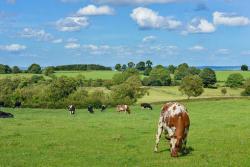 The team only studied organic farming in European dairy, but found that – for the same amount of milk – these systems caused at least one third more soil loss, and take up twice as much land, as conventional dairy farming.
The study authors say that high-yield farming must be combined with mechanisms that limit agricultural expansion if they are to have any environmental benefit. These could include strict land-use zoning and restructured rural subsidies.
“These results add to the evidence that sparing natural habitats by using high-yield farming to produce food is the least bad way forward,” said Balmford.
“Where agriculture is heavily subsidised, public payments could be contingent on higher food yields from land already being farmed, while other land is taken out of production and restored as natural habitat, for wildlife and carbon or floodwater storage.”
Publication date: 14 September 2018