
Is sugar good for us after all?
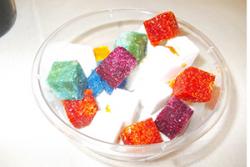 Is sugar good for us after all?
Scientists attending the COST IB CARB training school for Glycoscience think so.
Experts in the field of Glycoscience gathered from all over Europe to discuss the science of sugar at Âé¶čAV recently.
What is Glycoscience?
Glycoscience is the science and technology of carbohydrates (sugars). Sugars are the most abundant biological molecules on earth and make up part of the biology of all living organisms. Glycosciences are recognised worldwide as an emerging area with the potential for radically new biological applications with the potential to solve several of the challenges faced by modern society.
Why is it so important?
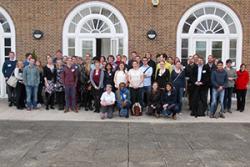 Conference delegates at Âé¶čAV.Dr Martina Lahmann from the School of Chemistry at Bangor explains: “Carbohydrates are produced from sunlight and carbon dioxide by plants, algae and some photosynthetic bacteria. Created by photosynthesis, carbohydrates provide the largest renewable biomass on earth and are the economically viable and sustainable alternative to fossil resources for energy and raw materials. Carbohydrates are the biomass that helps reduce carbon footprints, enabling economic growth without damage to the environment. Carbohydrates are essential to get biological systems working. Placed for example on the outside of a cell-wall they can behave like a flypaper, to make sure that other important molecules “stick†where they are supposed to or as a signpost for other bio molecules.â€Research at Âé¶čAV in this exciting field is conducted at the School of Chemistry where chemists are looking at ways to utilise complex carbohydrates (sugars) for the good of mankind. A recent example is the development of a potential vaccine suitable for protecting adults and very young children and investigating whether special sugars could be used instead of antibiotics.
Dr Lahmann who’s research is in this area and was hosting the COST/IBCarb training school at Âé¶čAV. She said: “It was fantastic to see so many highly motivated young investigators - all working in carbohydrate research – presenting their work. We were honoured to present the prestigious RSC/Dextra Carbohydrate Award to Matt Gibson from (the University of Warwick, http://www2.warwick.ac.uk/fac/sci/chemistry/research/gibson/gibsongroup/). His creativity and enthusiasm inspires both the young and the established researchers. I have to thank both the COST action 1102, the IBCarb and the RSC to enable us to have this event in Bangor. “
Publication date: 21 May 2015